The exhibition staffing checklist, in short
An exhibition staffing checklist has seven parts: lock the requirement, map the roles, size the registration counters, plan peak-hour cover, brief the crew, run each show day to a schedule, and close out after the last visitor leaves. Work through them in that order and most show-day problems disappear before they happen.
Exhibitions are different from conferences. The movement of visitors is constant, the gate pressure is concentrated in the first two hours of each day, and the crew at the entrance carries the organiser's reputation for the entire show. A crew that is briefed on the floor plan, the hall changeovers and the badge policy will hold that line.
This page is the checklist we use when organisers and stall-booking teams ask how to staff an exhibition in Bengaluru, Chennai, Mumbai, Delhi or Hyderabad.
Before the show: lock the requirement
An exhibition requirement is more detailed than a conference requirement, because it has to account for visitor volume, hall zones and stall holder needs. Collect it in one document and share it with your staffing partner before any quote is compared.
If stall numbers or visitor registrations are still firming up, give the agency the current estimate and the date by which it will be confirmed. Staffing is booked from the numbers you provide, so a late change is far easier to absorb when it is flagged early rather than on the morning of the show.
- Show dates, hall timings and build-up or move-out days
- Venue, hall numbers and gate locations
- Pre-registered versus walk-in visitor volumes
- Number of stalls, exhibitors and conference sessions
- Registration counters, badge desks and scanner points
- Dress code, uniform and language requirements
- VIP, media, buyer and delegation protocols
The roles an exhibition actually needs
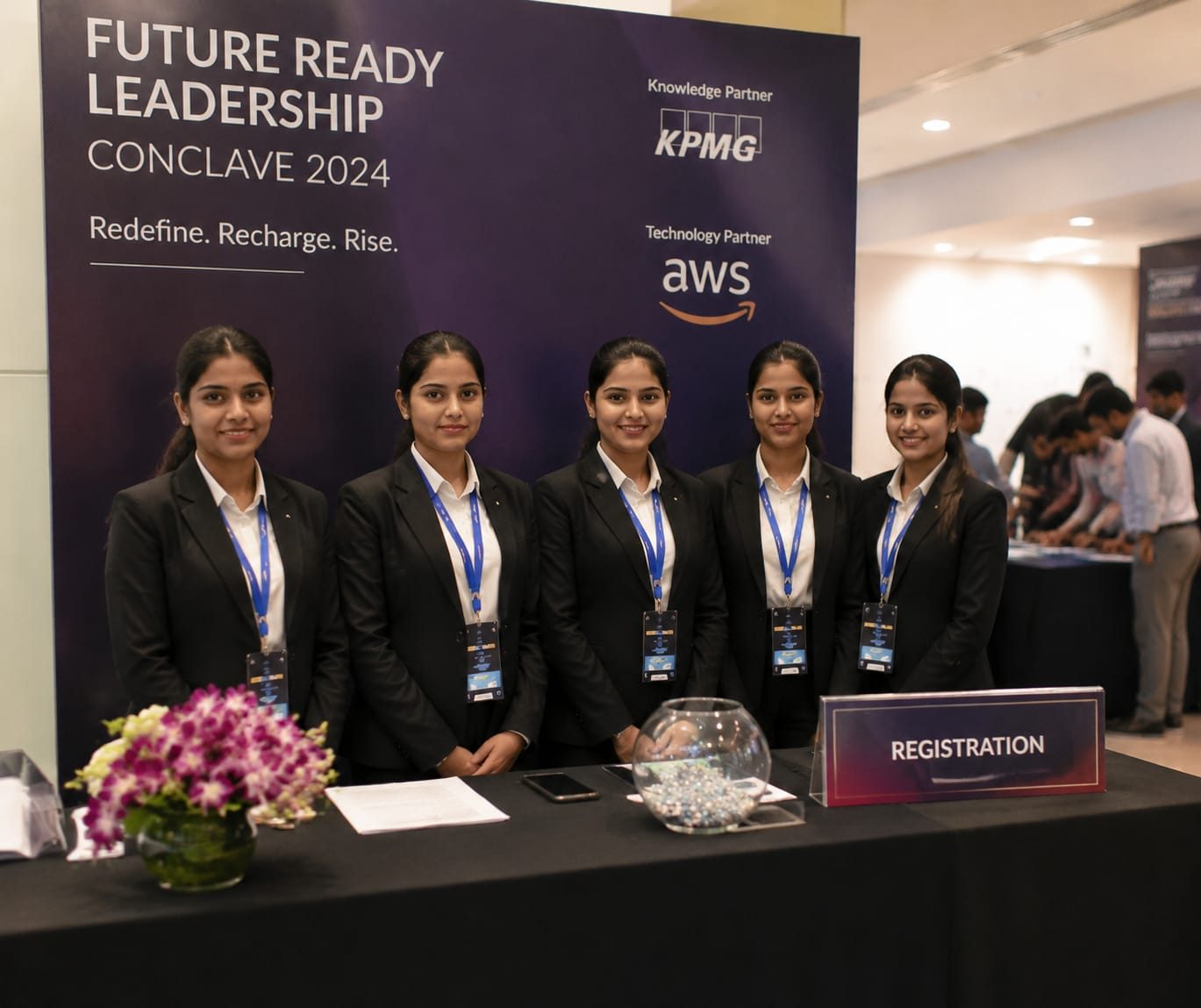
Exhibitions need roles that a corporate conference never asks for, and the mix is wider than most organisers expect. Registration and badge issue are the priority, because a queue at the gate sets the tone for the whole day.
Beyond the entrance, the floor needs staff who can direct visitors between halls, manage queues at popular stalls and support exhibitors who arrive short-handed. EventEdge combines specialist teams such as registration desk teams and crowd management into one exhibition crew, so a single partner can cover the gate, the floor and the conference stage.
- Registration desk teams — pre-registered check-in and on-site registration
- Crowd management — gate queues, hall entries and pinch points
- Volunteers and event crew — signage, directions and floor support
- Hospitality staff — buyer lounges and delegate refreshment areas
- Guest relations and VVIP handling — delegations and hosted buyers
- Hosts and anchors — stage sessions, announcements and awards
- Event coordination support — one point of contact for the organiser
Size the registration counters for the first two hours
The most common exhibition staffing error is sizing registration to the daily average. On most shows, a large share of visitors arrive in the first two hours of day one, and again in the first ninety minutes of each subsequent day. Counters that look generous on paper collapse under that pressure.
Work from the peak, not the total. If your largest expected arrival window is a few hundred visitors, plan the counters, scanners and crew needed to process that window without a queue forming outside the gate. Then hold a relief rotation so counters do not thin out when crew take breaks.
Keep a separate lane for pre-registered visitors and another for on-site registration. Mixing the two slows both, and it is the pre-registered visitor — your most engaged attendee — who notices first.
Booth staffing and lead capture
Booth staffing is a different skill from gate management. Booth staff hold product conversations, qualify visitors, operate demonstrations and capture leads. They need product briefing from the exhibitor, not just venue orientation from the organiser.
Agree early on who briefs booth staff and who supervises them. In most shows the organiser supplies floor and registration crew while exhibitors brief their own stall teams. When the organiser supplies booth staff too, the product briefing has to be arranged with each exhibitor before the show opens — and that is a conversation to start weeks out, not on build-up day.
Booth staff should also know the stall's busiest hours, where the nearest lead-capture device is, and who to escalate a complaint to. Those three details prevent most booth-floor confusion.
- Who briefs booth staff on the product
- Who supervises them across the show day
- Which team captures leads and who owns them afterwards
The staffing checklist by timeline
Spread the checklist across the weeks before the show so nothing lands in the final forty-eight hours. The table below is a working sequence, not a fixed rule — larger shows simply start each stage earlier.
Treat build-up and move-out days as staffing days in their own right. They are physically demanding, they run to different hours, and they are the days on which crew numbers quietly get cut.
Give every line on the checklist a single owner. On multi-hall shows the requirement is often split between the organiser, the venue and the stall-booking team, and items fall through the gap between them — usually the badge policy and the gate list, which are exactly the two documents the crew cannot work without.
| Stage | What to complete | Who owns it |
|---|---|---|
| 4-6 weeks out | Confirm dates, halls, footfall estimate and role mix | Organiser with staffing partner |
| 3-4 weeks out | Approve headcount, shift pattern and uniform standard | Organiser and staffing partner |
| 2 weeks out | Share floor plan, gate list, badge policy and escalation path | Organiser |
| 1 week out | Confirm crew list, reporting points and supervisor names | Staffing partner |
| Build-up day | Brief crew on halls, signage and move-in access | Staffing partner with venue |
| Each show day | Pre-open huddle, position check, break rotation, close-out | On-site coordinator |
| Move-out day | Crew for dismantle support and lost-property handover | Organiser and staffing partner |
Brief the crew before the gates open
Every exhibition briefing should cover the same five things as any event deployment: how to reach the venue and which gate to use, what the role does hour by hour, what to wear, who to escalate to, and what the visitor-facing standard is.
Add three exhibition-specific items. First, the hall map with the crew's own positions marked. Second, the badge and access policy, including what to do with a visitor who has no registration. Third, the exhibitor escalation route, because stall holders will approach your crew with problems that belong to the organiser.
Run a short huddle before each show day opens. It takes a few minutes and it catches the changes that happened overnight.
Deliver the briefing in writing before build-up day and confirm it verbally on site. Exhibition crews are often split across halls, so a single group briefing cannot carry the hall-specific detail — brief by hall, and make sure the badge and access policy is worded identically for every one of them.
- Which gate the crew uses and where they report
- The hall map with every position marked
- Badge and access policy for unregistered visitors
- Escalation route for exhibitor complaints
Running each show day
Show days should run to a fixed rhythm: crew report early, supervisor checks positions before the gate opens, counters open on time, breaks rotate so no desk is left thin, and the close-out is documented at the end of the day.
Watch three moments. The gate rush at opening, the lunchtime lull when crew attention drops, and the final hour when visitor numbers fall but questions about tomorrow's timings rise. Each one needs a different posture from the same crew.
Keep one coordinator free of a fixed position for the whole day. Someone has to move between the gate, the halls and the organiser's office without abandoning a desk.
Document the day at close: crew present, positions covered, incidents and any equipment issue. A written close-out takes five minutes and settles most disputes before they start, and it gives you the two numbers that matter for next year — visitors per hour at each gate, and the points where a queue formed.
After the show: close out properly
Close-out is where organisers recover time and money. Return badges, scanners and uniforms through one named person, log any equipment damage or loss, and hand lost property to the venue or organiser with a written note.
Capture two numbers while the show is fresh: visitor counts per hour at each gate, and any point where a queue formed. Those two figures are the most useful input for next year's registration staffing plan, and they are almost never written down.
Then debrief with your staffing partner within a week. What held, what broke, and what the crew reported from the floor. Exhibition crews see more of the show than anyone else on site, and their feedback is the cheapest planning tool you have.
- Return badges, scanners and uniforms through one named person
- Log equipment damage, loss and lost property in writing
- Record visitors per hour and every point where a queue formed
Frequently asked questions
How many staff does an exhibition need?
It depends on visitor volume, number of gates, hall layout and show days. Crews scale from 5 to 500 staff per event, and the count should be built from peak arrival volume rather than the daily average.
Can the same crew handle registration and booth staffing?
They are separate jobs. Gate and registration crew follow the organiser's venue briefing, while booth staff need product briefing from each exhibitor. Some crew can cover both across different shifts, but the briefing must be planned separately.
Do you provide crew for build-up and move-out days?
Yes. Build-up and move-out days can be staffed as separate deployment days with their own reporting times and shift lengths.
How far in advance should an exhibition crew be booked?
Four to six weeks gives comfortable time to confirm requirement, uniform and briefing. EventEdge has 24-hour deployment capability, so shorter notice can be handled subject to availability.
Can you staff exhibitions outside Bangalore?
EventEdge is headquartered in Bengaluru with live coverage in Chennai, Mumbai, Delhi, Hyderabad and Kerala, and is expanding into Kolkata, Pune and Goa.