
Event Staffing Cost Factors in Bangalore
What actually drives event staffing cost in Bangalore — role mix, shift length, headcount, venue distance, supervision scope and lead time — and how to compare quotes.
Fast quotation turnaround — itemised staffing proposals typically within 2 working hours, subject to receiving complete event requirements.
Send your briefEventEdge Staffing
Crowd management staff hold entry gates, queue lanes, holding areas and exits so crowds move in an orderly way and pressure points are spotted early. This page explains what marshals do, the calm-and-observation qualities to look for and how gates and lanes drive headcount. Share your venue capacity and gate plan to size the team.
The ratios below are planning estimates only, offered to help you draft a requirement. They are not a quotation and not a guarantee of safety, attendance or any outcome. Final headcount is confirmed after we review the venue capacity, gate and lane layout, the venue's own security plan and the show timings.
| Gate, lane or area | Indicative crowd management planning guide |
|---|---|
| Each entry gate with ticket scanning | 2 marshals on the gate and 1 per queue lane feeding it |
| Each holding area before gates open | 2 to 4 marshals, with 1 lead for the area |
| Aisle or barricade line inside the venue | 1 marshal roughly every 10 to 15 metres of line |
| Exit and dispersal routes at close | 1 marshal per exit route, plus 2 for the transport pick-up point |
| Venue of 2,000 plus capacity | A supervisor per zone, a floor lead for the venue and a relief pool on standby |
Crowd management works best as two layers. Marshals hold posts, keep lanes orderly and watch density; venue security handles enforcement, searches, ejection and any legal authority.
The marshals' value is early warning. A marshal who notices a lane backing into a road or a holding area too full to receive another batch gives the venue time to act before a problem develops.
Clarity between the layers is essential. Every marshal should know what they are authorised to do, what they must not do, and exactly who to call in each situation.
Every marshal needs a post, not a vague instruction to manage the crowd. Write the gate, lane, holding area or exit route onto the role card, along with the relief time and the supervisor's name.
Then walk the posts. Before the gates open, the team should stand at their positions, understand the flow in front of them and know where the crowd will be held if a gate saturates.
Finally, confirm the escalation numbers and the shared channel on the day. Radios and phone numbers that are only exchanged at the moment of an incident are useless.
Entry is the most predictable pressure point, so gates and lanes should be planned for the arrival peak rather than the average. Staggered entry reduces the load on scanning and search.
Holding areas give a gate time to recover. Where arrivals exceed the gate's throughput, holding arrivals in a designated area with marshals is far safer than letting the lane compress against the gate.
Dispersal deserves the same planning as entry. Exits, transport pick-up points and reverse-flow control determine how the event ends, and marshals should be posted for it in advance.
Marshals manage flow, queues and posts, and escalate incidents to venue security. Security staff carry the authority to enforce entry, search and ejection. The two work together, and the venue's security plan always governs.
As a planning guide, plan two marshals on the gate itself and one per queue lane feeding it. Where the lane carries a heavy arrival surge, add a marshal at the tail of the lane to keep the line orderly.
Yes, with a written plan. VIP movement is briefed separately, with the guest's route kept clear and the crowd held in a designated area so the arrival does not create a surge.
Many deployments are outdoor or semi-open, so uniform and footwear are chosen accordingly and rotation is planned for heat and long standing hours.
Marshals report to an EventEdge coordinator, who coordinates with the venue security team and your event team through one agreed communication channel.
Planning notes
What actually drives event staffing cost in Bangalore — role mix, shift length, headcount, venue distance, supervision scope and lead time — and how to compare quotes.
Trade shows are staffed to a different standard than conferences: higher volumes, longer days, tighter compliance. These are the seven requirements to meet before day one.
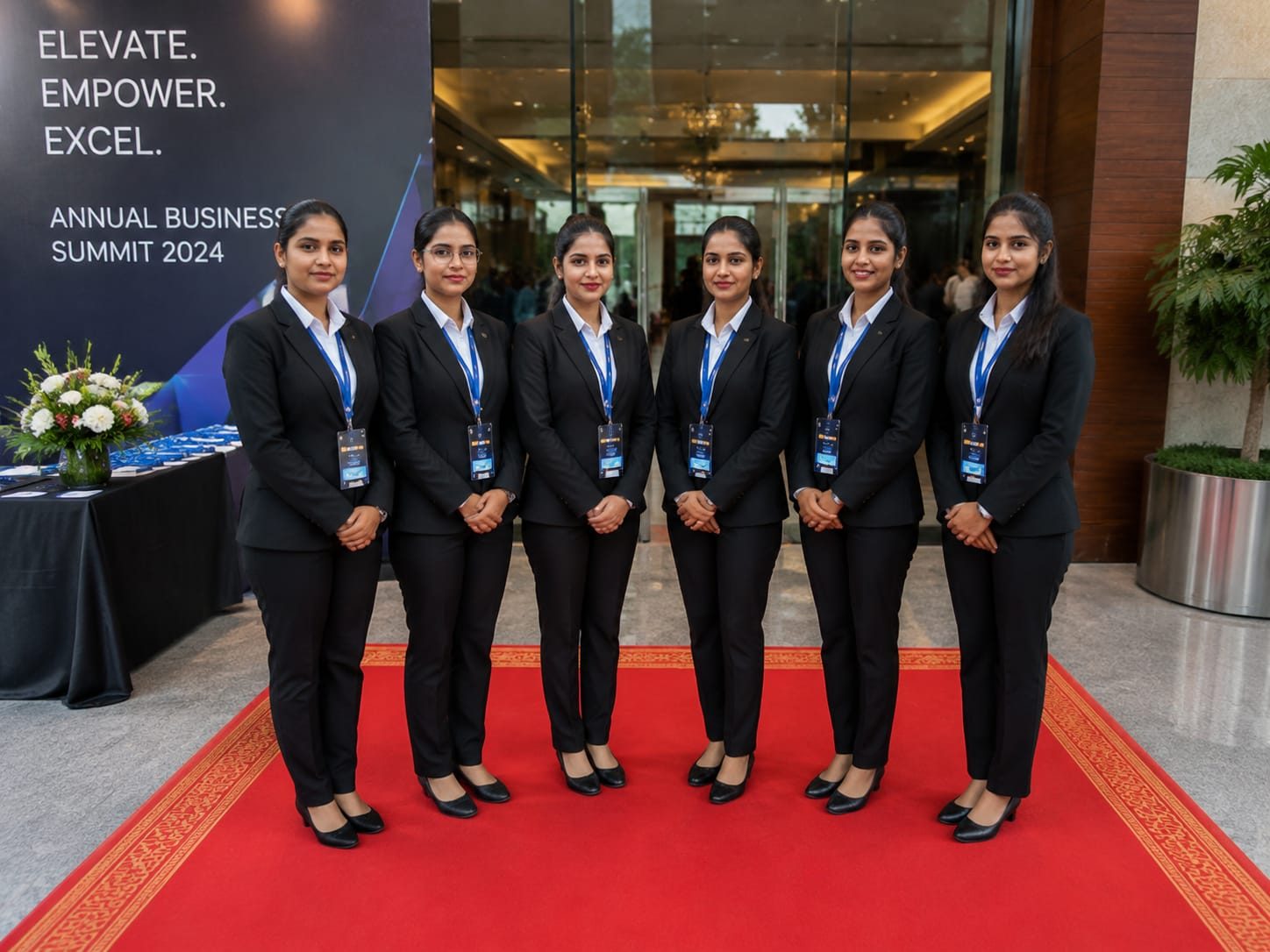
The briefing is what separates a deployed crew from a list of names. Here is what every pre-deployment briefing must cover, and how to run it consistently at scale.